23
Jul

Date
19 August 2026
Author
JPC Direct
Estimated reading time
11 minutes
Choosing the right bow thruster power is one of the most important parts of a successful installation. If the unit is too small, it may struggle in windy or tight conditions. If it is too large, you may end up spending more than you need to and taking up more space than necessary.
At JPC Direct, we often speak to boat owners who know they want the extra control a bow thruster brings, but are not sure how powerful it should be. This guide explains the main things to think about so you can choose a setup that feels right for your boat.
As a general guide, the right bow thruster depends on more than just boat length. You should also consider windage, hull shape, weight, and the conditions you usually boat in. A well-matched thruster will give you better control, easier berthing, and a more confident handling experience.
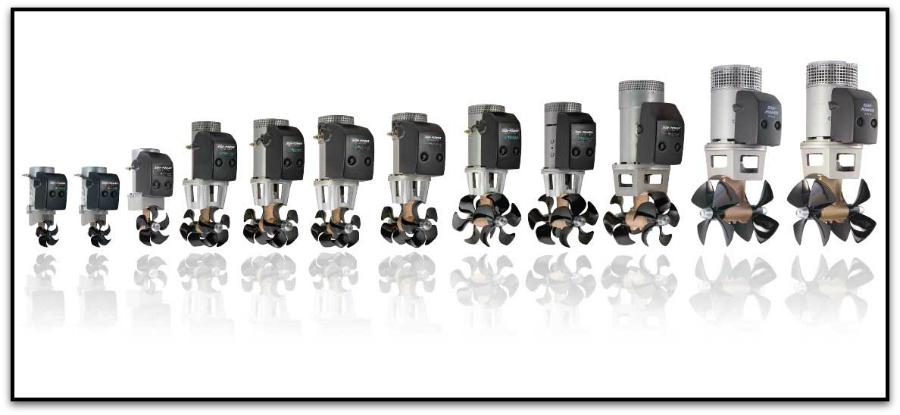
A bow thruster is there to make low-speed manoeuvring easier, especially when you are berthing, leaving a tight marina, or correcting for wind and current. The right amount of thrust helps the boat respond quickly and predictably.
If the thruster is underpowered, you may not get the control you expected. If it is matched well to the boat, it should feel like a real help rather than a system you have to fight with.
There is no single number that suits every boat. The right bow thruster power depends on the size of the boat, how much windage it has, and where it will be used.
As a general guide, many bow thrusters are matched to boat length, but this should only ever be a starting point. A lightly built boat with low windage, for example, may need less power than a shorter boat with a tall cabin and lots of exposed surface area.
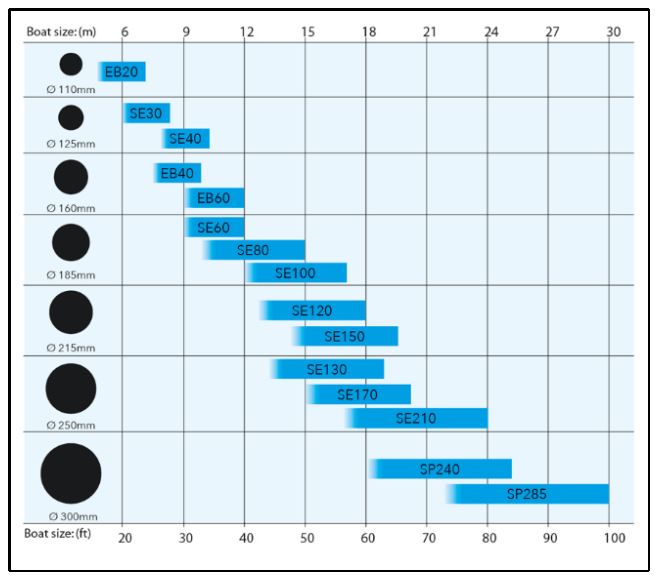
| Boat length | Typical thruster power | Sleipner thruster range |
| 5.5 – 8.5m | 25 kgf | SE25 / SEP25 / SE30 class models |
| 6.5 – 10m | 35 kgf | SE30 / SEP30 class models |
| 8.5 – 12.5m | 55 kgf | SE60 / SEP60 class models |
| 9 – 13m | 60 kgf | SE60 / SE80 class models |
| 10.5 – 15m | 75 kgf | SE80 / SE100 class models |
| 12 – 17m | 95 kg | SE100 / SE120 class models |
* NB: This table is only a guide. The real answer depends on the boat’s shape, weight, and the conditions in which it is used.
Sleipner is widely regarded as one of the leading names in thruster technology, with a broad range of bow and stern thrusters designed for everything from smaller leisure boats to large yachts and commercial applications. Their range includes compact tunnel thrusters, retractable systems, external pod thrusters, and high-output hydraulic units, so there is usually a model to suit different hulls, spaces, and power needs.
What sets Sleipner apart is the focus on performance, reliability, and smart engineering. Features such as Q-PROP™ for reduced noise, Intelligent Power Control, sealed gearlegs, galvanic isolation, and variable-speed PRO™ and eVision systems all help improve comfort, safety, and ease of use on board. For many boat owners, that combination of range and technology makes Sleipner a natural choice when choosing the right amount of thrust.
Sometimes boat owners choose a thruster based on length alone, then later find it does not quite feel strong enough. That usually happens when the boat has more windage than expected or is used in more exposed locations.
It is also possible to choose too much thruster power. That can increase cost, installation complexity, and space requirements without giving you much extra value.
Power is only part of the decision. The type of thruster and the quality of the installation matter just as much. A well-chosen smaller thruster can feel more effective than a badly installed larger one.
Where the thruster is placed can affect how well it works. A forward installation usually gives the unit more leverage, which helps it move the bow more effectively.
That means two boats of similar length can behave very differently if the thruster is positioned differently or if the hull shape changes the way the boat reacts to wind.
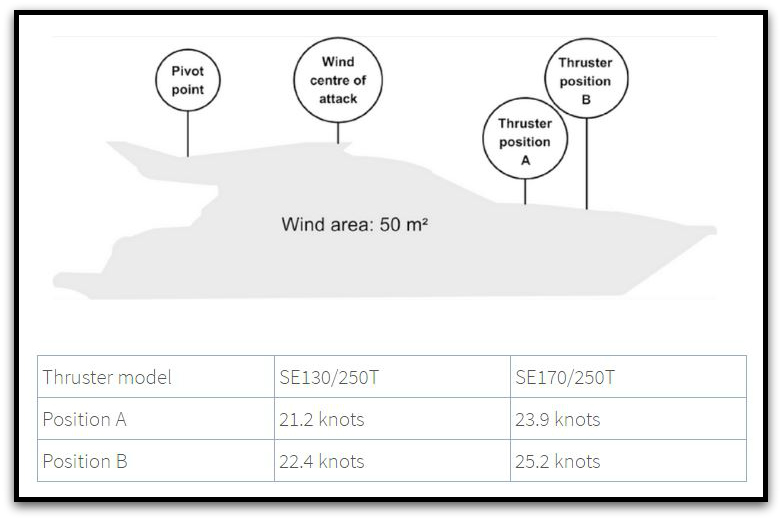
The example above shows the different wind speeds that two different thruster installations can counteract, and the increased leverage when the thruster is further forward.
If you cannot fit a tunnel in a satisfactory position, you might want to consider a retractable or external thruster instead.
It is wise to play safe by installing the largest tunnel diameter you can fit, within the guidelines of minimum depth below the waterline and tunnel lengths.
The reason for this is that the smallest tunnel diameters with a larger motor create fast water flow through the tunnel to achieve the rated output.
Typically, larger tunnels have lower water speed, which reduces the risk of water cavitation that impacts both efficiency and noise.
Voltage drop (caused by resistance from cabling, main switch, fuse, and the like) might have a greater effect on thrust power than some manufacturers have led you to believe.
To obtain the rated performance of a thruster, it is necessary to allow for loss of voltage through the battery cables, main switch, and fuse.
Typically, in a 12V system, you will find that you only get 10-11 volts reaching the electric motor.
This is a significant reduction that affects the thruster’s output.
If you have decided you need 130 kilos of force for your vessel, but only get 110, you will probably be disappointed.
Make sure that you look at the rated thrust at say 10.5 volts, which is a typical value in a decent installation.
You can also consider installing a dedicated battery close to the thruster to reduce voltage drops through very long battery cables.
Remember that the battery needs an enclosed and ventilated battery enclosure if installed in a cabin.
As mentioned, some manufacturers state the rated thrust at ambitious voltage levels, and make it difficult to compare brands. Make sure you know the true thrust performance before deciding on a specific model.
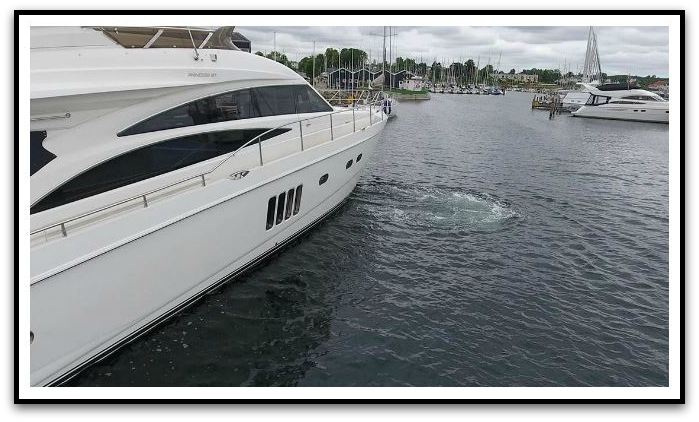
A stern thruster does not require more thrust to have the same effect as a bow thruster.
This is because the stern thruster is mounted outside the hull, and further from the boat’s pivot point. This is how it gains more leverage.
Depending on boat type and windage of the boat, the same size or the model below will, for most, be an excellent match to the bow thruster, if sized correctly when installed.
If there are obstacles in the water flow, or to and/or from the stern thruster, more thrust might be necessary to match the bow thruster.
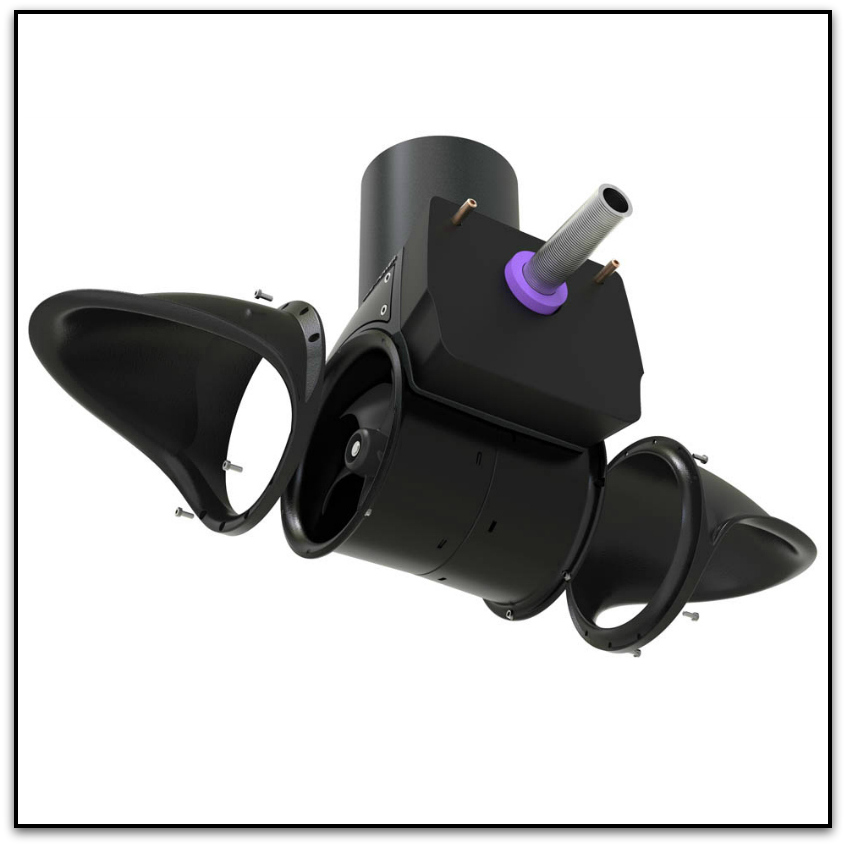
Installing cowls can also be a good solution, guiding the water flow away from obstacles.
Installing a thruster that is too small is a waste of money.
In the harshest conditions you need the extra manoeuvrability to dock your boat safely.
If the thruster system is under-sized and cannot give you the help you need when you’re caught nasty weather, your investment hasn’t paid off.
You rarely hear anyone complain about their thrusters being too powerful.
There are countless stories, though, where people have had bad experiences in situations where they did not have enough power to manoeuvre safely, which is worth remembering.
If you do go all in and install a powerful thruster system, you should consider upgrading to a proportionally controlled system.
Standard thrusters are on/off – full speed or nothing.
In a powerful system, you will probably need a lot less power in normal conditions, and putting a throttle in your thruster allows for quiet and controlled docking when running the thruster at lower RPMs.
The two main factors that decide the correct thruster size are the vessel’s wind area and the boat owner’s demand for performance.
Always take into account the prevailing weather conditions in your area, along with an accurate idea of the maximum strength of tide.
Choose a thruster that can push the bow or stern against a minimum of 17.5 knots wind speed.
For comparison, a powerful thruster operates in winds of 22-25 knots.
The difference between the two may not appear much, but will offer very different user experiences.
The best starting point is your boat length, but that should not be the only factor. Windage, hull shape, weight, and the conditions you normally boat in all matter. A boat with a tall profile may need more power than a longer but lower boat.
Not always. A bigger thruster can be useful, but it may also cost more, take up more space, and require more from your electrical system. The best thruster is the one that suits your boat’s actual needs, not just the biggest available option.
Sleipner offers one of the widest and most advanced thruster ranges on the market, from compact tunnel units to high-output hydraulic systems. Features like Q-PROP™, IPC, and eVision technology are designed to improve quietness, efficiency, safety, and control on board.
For smaller boats, Sleipner’s SE25 and SE30 families are a strong fit. These compact thrusters offer around 25–40 kg of thrust depending on the model and setup, making them suitable for smaller leisure craft where space and weight matter.
Not necessarily. The stern thruster can often be smaller because it works differently and may need less force. The right setup depends on how your boat handles and how much control you need at each end.
At JPC Direct, we help boat owners choose marine equipment that fits their boat and their boating style. If you are unsure how much bow thruster power you need, we can help you think through the practical side of the decision rather than just the numbers.
The best choice is not always the biggest one. It is the one that gives you the right balance of control, reliability, and value.
23
Jul
20
Jul

16
Jul
09
Jul

08
Jul

06
Jul

13
Apr

09
Apr

15
Feb
06
Jan
28
Sep
22
Sep

18
Jul

14
Jul
14
Jul
14
Jul
14
Jul

14
Jul
08
Jul

05
Jul

11
Mar
15
Sep
25
Aug

29
Jul